
Could Cybersecurity Become Broadband’s Next Revenue-Generating Service?
For decades, automakers competed primarily on performance. Horsepower, acceleration, handling, and fuel efficiency helped distinguish one vehicle from another. Then safety became a more prominent part of the purchase decision.
Features such as airbags, anti-lock brakes, collision detection, blind-spot monitoring, and automatic emergency braking evolved into premium options and important measures of vehicle quality. Consumers still care about performance, but they also look for the vehicle to actively protect them.
Broadband may be approaching a similar inflection point.
Providers have traditionally competed on speed, price, coverage, and reliability. Those factors will remain important, but as multi-gigabit broadband and advanced Wi-Fi become more widely available, performance alone will become increasingly difficult to differentiate.
Cybersecurity could become broadband’s equivalent of automotive safety: a sought-after capability, meaningful reason to choose one provider over another, and a potential source of new recurring revenue.
Consumers Want More Than a Fast Connection
Cybersecurity is no longer a concern limited to highly technical users. Consumers routinely encounter phishing attempts, fraudulent transactions, malicious websites, identity theft, and increasingly sophisticated AI-generated scams. Meanwhile, the connected home includes a growing collection of smart TVs, cameras, speakers, gaming systems, appliances, and other devices.
According to the F-Secure US Scam Intelligence & Impacts Report 2026, 69% of US consumers encounter scam attempts at least monthly, while 15% report having fallen victim. Among those victims, 57% lost money.
Consumers increasingly expect their communications providers to help. The research found that 93% believe it is important for their telecommunications provider to offer cybersecurity. Security influences provider choice for 82%, and 48% say they would pay for scam protection.
These findings elevate cybersecurity from a technical feature to a business consideration. Consumers are not only concerned about online threats; many are willing to consider security when selecting and paying for broadband service.
For providers facing slowing subscriber growth, increased competition, and pressure on connectivity margins, that demand represents a significant opportunity.
Speed Is Broadband’s Horsepower
The automotive comparison helps explain the shift.
A vehicle can offer impressive horsepower, but performance has limited value if drivers do not feel safe. In the same way, a multi-gigabit broadband connection delivers less value if subscribers do not feel confident shopping, banking, working, or connecting devices online.
Automotive safety also changed from being primarily reactive to increasingly proactive. Seat belts and airbags help protect occupants during a collision. Newer systems attempt to identify risks and intervene before the collision occurs.
Broadband cybersecurity can follow a similar path. Instead of relying entirely on subscribers to recognize and respond to threats, the network can help detect suspicious activity, block known malicious destinations, and prevent some threats from reaching household devices.
The Gateway as a Cyber Threat Mitigation Platform
Traditional consumer security has focused primarily on endpoint software installed on laptops and smartphones. That approach remains important, but it cannot protect every device in the connected home.
Many smart-home and IoT devices cannot run conventional security applications. Consumers may not know how to update them, configure their security settings, or identify unusual behavior.
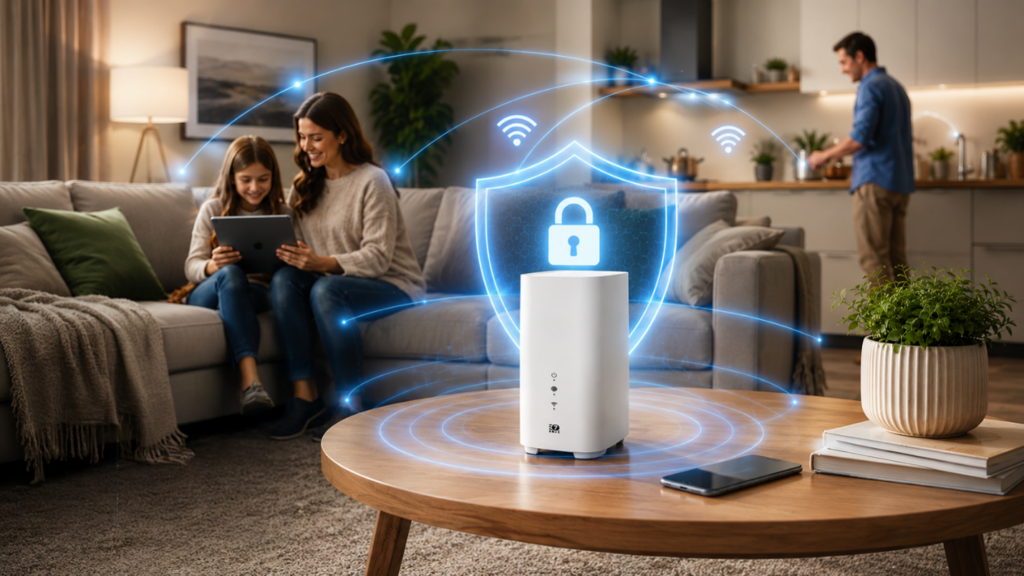
The broadband gateway is well positioned to help close this gap. It already sits between the home network and the internet, handling traffic for the connected devices. With embedded security capabilities and cloud-based threat intelligence, it can evolve from a connectivity appliance into a cyber threat mitigation platform.
Gateway-level security with the right solution can help identify connected devices, block known malicious and phishing websites, disrupt connections to attacker-controlled systems, recognize suspicious device activity, reduce unwanted tracking, and apply protection policies across the home.
This makes protection more comprehensive and easier to use. Subscribers do not need to install software on every television, camera, speaker, or appliance. Security can be delivered automatically through infrastructure the provider already manages.
The gateway becomes more than the equipment enabling broadband. It becomes the platform through which the provider delivers protected connectivity.
Building a Service Consumers Will Value
The revenue opportunity does not come from adding a security label to a broadband package. Providers must translate technical capabilities into outcomes consumers understand.
Terms such as DNS filtering, botnet blocking, and command-and-control detection may be meaningful to security professionals. Subscribers are more likely to value benefits such as:
- Family controls for children’s devices
- Greater peace of mind when going online
- Safer online shopping and banking
- Protection against malicious websites
- Alerts about suspicious activity
- Visibility into devices connected to the home
Operators could package these capabilities in several ways. Basic network protection might be included in a premium broadband tier. More advanced features could be offered through a monthly whole-home security subscription. A broader digital protection bundle could combine gateway security with endpoint protection, identity monitoring, privacy tools, and family controls.
Each approach creates a different balance among adoption, differentiation, and recurring revenue. The important point is to position cybersecurity as an ongoing managed service, not a one-time router feature.
The Business Case Extends Beyond ARPU
Premium subscription revenue is the most direct opportunity, but the potential value extends further.
A visible security offering can help attract subscribers who are concerned about scams and online threats. It can improve retention by adding another meaningful service to the provider relationship. Security alerts, device notifications, and family controls can also increase digital engagement by regularly demonstrating value.
There may be operational benefits as well. Blocking malicious traffic close to its source can reduce botnet activity originating from subscriber devices. Better device visibility can provide support teams with more context when diagnosing connected-home issues. Proactive notifications can help address potential problems before they become support calls.
Cybersecurity can therefore contribute across customer acquisition, premium-service revenue, subscriber retention, brand differentiation, digital engagement, and operational efficiency.
Moving From Managed Wi-Fi to Managed Trust
Automakers ultimately learned that performance and safety are not competing propositions. Together, they create a better vehicle and a stronger brand.
Broadband providers have the same opportunity. Speed, coverage, and reliability establish the foundation of the service. Cybersecurity can make that service more valuable, more differentiated, and more closely connected to what subscribers increasingly need.
Today’s gateways should not only provide speed and performance; they should help identify connected devices, recognize suspicious behavior, apply protection policies, and mitigate threats at the network edge.
In this model, the gateway is no longer simply the device that connects the home. It becomes a platform for managing both connectivity and digital trust.
Broadband speed will always matter, just as horsepower still matters in automobiles. But in an increasingly connected and vulnerable world, protection may become the capability that gives consumers greater confidence, and gives broadband providers their next revenue-generating service.